How to Open a Corporate Bank Account in the UAE: Documents, Timeline and Common Rejections
A trade licence makes a company exist; a bank account makes it work. Opening a corporate account in the UAE is a compliance exercise more than a banking one, and most delays come from documents that are missing, inconsistent or unexplained. Here is what banks actually look for, how long the process tends to take, and the reasons applications get stuck.
What the bank is really assessing
Under UAE anti-money-laundering rules every bank must understand who owns the company, where its money comes from and what it will do. The application is therefore a story told in documents: the licence says what you may do, the memorandum says who owns it, the invoices and contracts show that the activity is real, and the bank statements show where the capital came from. When the story is consistent, accounts open; when it is not, the file sits with compliance.
The documents banks usually ask for
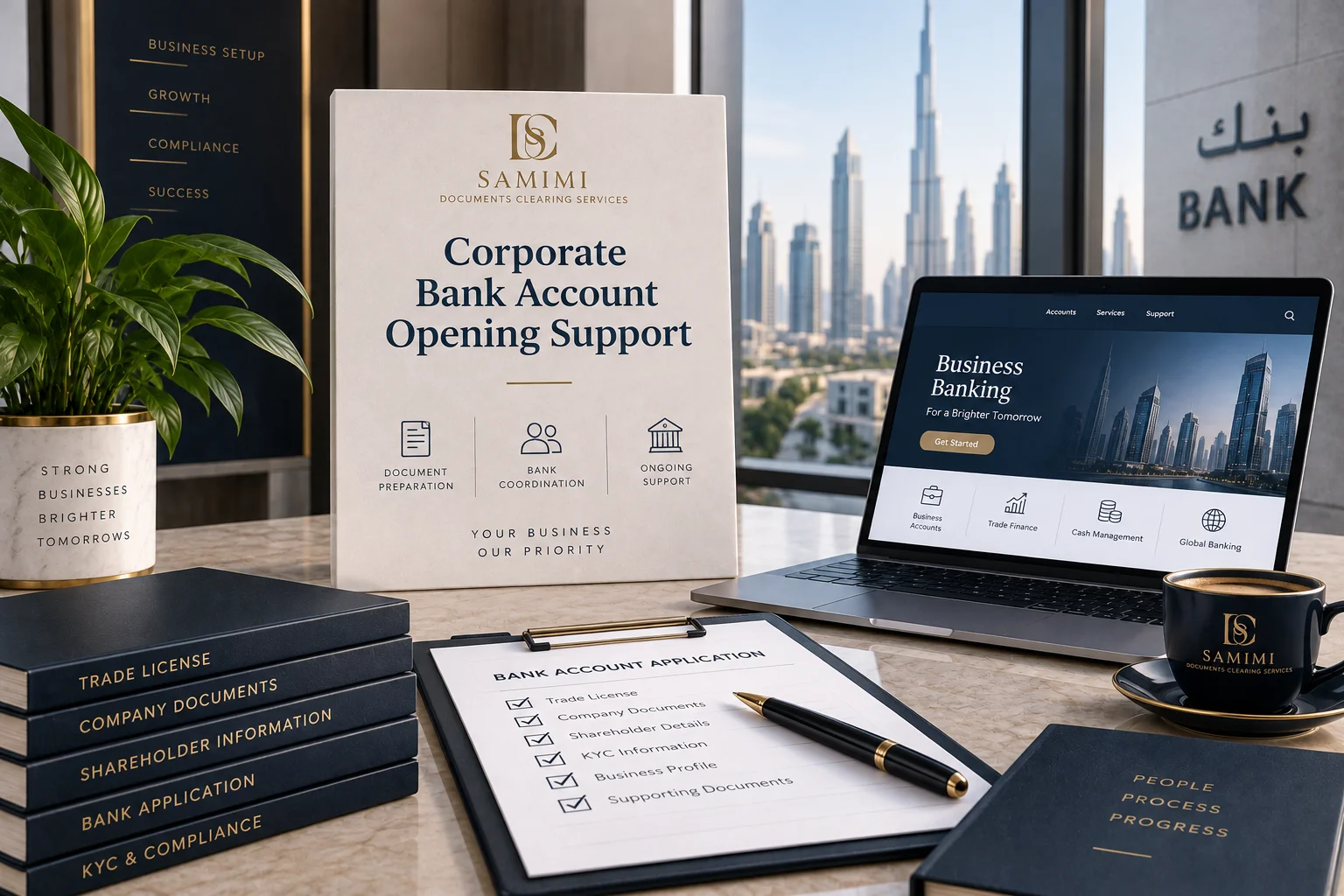
- Valid trade licence and, for free zone companies, the certificate of incorporation.
- Memorandum and Articles of Association, or the zone equivalent, showing the shareholding.
- Passport copies, UAE residence visas and Emirates IDs of shareholders and authorised signatories.
- Board resolution or shareholder resolution authorising the account and naming the signatories.
- Office tenancy contract (Ejari) or the free zone lease.
- A short business plan or company profile: what you sell, to whom, expected monthly turnover and the countries you will deal with.
- Evidence of activity: recent invoices, quotations, contracts or purchase orders.
- Source-of-funds evidence for the opening deposit and for the shareholders, such as personal bank statements, salary certificates or a sale agreement.
Banks vary in the exact list and may ask for more once they have seen the first set. Sending a complete, well-organised pack on the first day is the single biggest accelerator.
Timeline
Expect several weeks rather than days. A straightforward mainland trading company with UAE-resident shareholders and a clear business can open within a few weeks; companies with non-resident owners, complex group structures, higher-risk sectors or unusual payment flows take longer because the file passes through additional compliance review. Digital-first banks can be quicker for simple cases, but they apply the same rules.
Why applications are declined or delayed
- Unclear source of funds. A large opening deposit with no paper trail is the most common reason for a return to the applicant.
- Activity mismatch. The licence says consultancy, the invoices say trading. Keep the licence, the contracts and the description consistent.
- No UAE-resident signatory. Most banks want at least one signatory with a UAE residence visa and Emirates ID.
- Higher-risk sectors. Crypto, precious metals, general trading with many countries, and certain jurisdictions in the ownership chain all trigger enhanced review.
- Thin business plan. Two paragraphs of generic text do not answer the compliance team's questions; specific customers, suppliers and countries do.
- Expired or inconsistent documents. A passport with a different spelling from the licence, or a lease that has lapsed, stops the file until fixed.
Practical tips before you apply
- Obtain the signatory's residence visa and Emirates ID first where possible; it removes the most frequent objection.
- Choose the bank by fit, not by brand: some serve SMEs and free zone companies far better than others.
- Prepare the source-of-funds file as carefully as the licence file.
- Answer follow-up questions the same day; files that go quiet are the ones that get closed.
How Samimi DCS helps
We assemble and check the complete application pack, match it to the bank's own checklist, prepare the board resolution and company profile, and coordinate the meetings and follow-ups with the relationship manager until the account is active. Where a document is missing, we tell you exactly what will satisfy the bank instead of letting the file bounce.
Each bank applies its own policy and may request additional documents at any stage. We confirm the current requirements with the chosen bank before submission.